

The webinar featured discussions and statistics regarding the professional roles that women currently hold in China and Japan and the obstacles that are in place to slow their progression into leadership roles in the wider APAC region.
Research and statistics
The first of the panelists to introduce themselves and discuss their findings was Bettina. Bettina is a gender researcher, author, and advisor for corporate diversity programs, and has an international background in China, Japan, France and Germany. She has a PhD in Diversity and Global Women Leadership, and a certified coach.
She explained how professional advancement differs for men and women. While the path is the same length, women face more obstacles.
In 2021, women held only 31% of senior management roles globally, with Japan at just 9%. In contrast, China had 38%. Across APAC, women in leadership made up 28%, while the ASEAN region ranked higher at 38%.

Global Women Career Lab—an international research and training initiative—was founded by Bettina. She shared Global Women Career Lab’s qualitative research pool details. When carrying out research opportunities, 115 top female managers from 5 nations (with their career paths spanning 21 countries), 27 male CEOs and C-suite executives from 11 countries, over 530 companies involved in their career paths, and 2,750 interview pages are used to collate their research information. From this research, Bettina revealed that on a scale of 0 to 10 (0 equal to no gender equality, and 10 being full gender equality), Japan rated at just 2, with China rating the highest at 8.5. France, Germany, and Russia ranked in the middle, at 5.
When discussing her network, and her experience researching the gender gap in different countries, Bettina shared some tips from female global role models. Freeing yourself from expectations and societal norms, setting clear career goals and generating a strong motivation to rise to those senior levels, and finding your self-confidence were the top tips, as well as understanding the corporate system.
Boyd & Moore Perspective
Anne, BMES Managing Director in China, was the next speaker. With 18 years of experience working with international clients on talent and leadership solutions, Anne has worked with many companies growing in the APAC region and has helped them tackle challenges during different development phases. She is a certified assessment consultant, coach, an executive search professional.
Anne opened by sharing details of Boyd & Moore’s executive search solutions. She revealed that BMES utilizes its two decades of experience in the APAC region, over 100 research professionals in the Boyd & Moore Intelligence Center in India, and its passion for diversity and inclusion, to provide client companies with a variety of services. Anne mentioned how important diversity is within Boyd & Moore as a company, sharing that 48% of employees in the APAC region are female, including the Managing Directors in China, Vietnam and India.
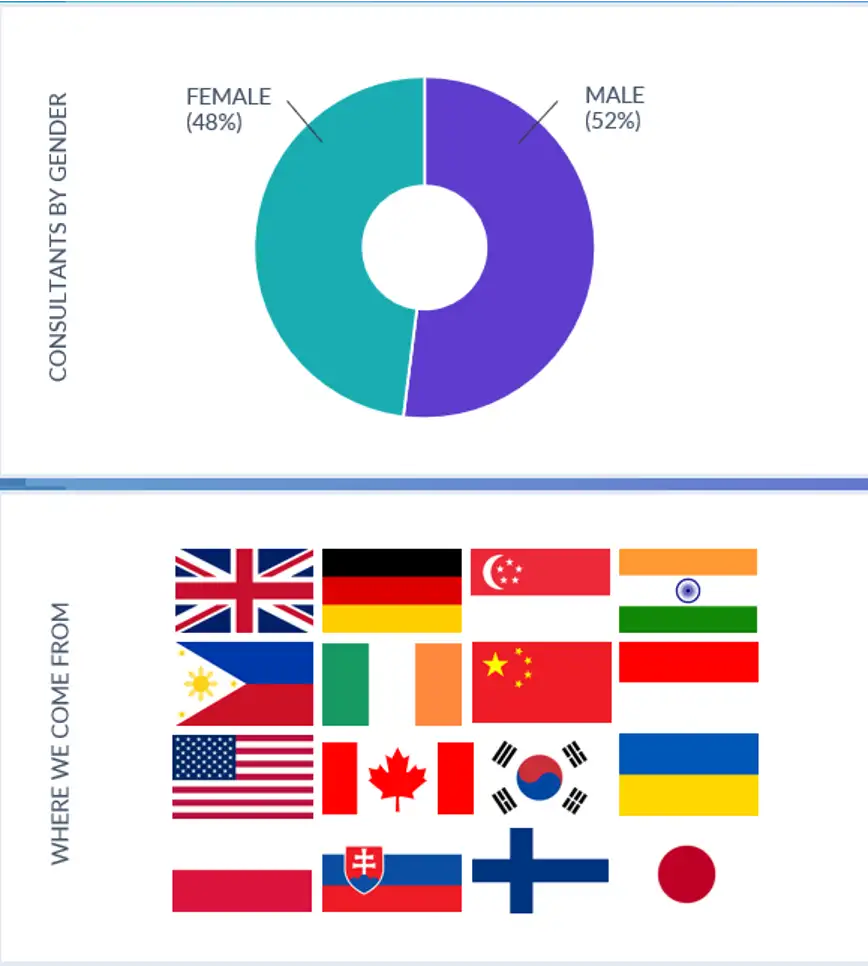
Anne went on to pose insightful questions, such as: What has been the trend in the Executive Search business in China when hiring for Country or Regional leadership roles? And how are female candidates progressing with these new career opportunities? Anne explained that the main trend is the localization of leadership. 10–15 years ago, Chinese companies were hiring a lot of expatriates for executive roles, but in the last ten years it has been more focused on local leadership talent.
Some of the leadership roles that Boyd & Moore has handled over the last five years was shared, ranging from Head of Marketing roles in APAC, to an MD role in Greater China. The ratio of female candidates out of all executive search mandates in APAC is 28%, according to the Boyd & Moore Intelligence Centre.
Professional pipeline
Next to present was Karin, partner and chief operating officer at Kay Group K.K. Japan. Karin is a professional, certified coach, with well over two decades of management and consulting experience in Europe, North America, East and Southeast Asia. Karin spends a lot of time focused on DEI, women in leadership, and leadership branding.
She began by examining the lifecycle of leadership assignments in Japan. She explained that the onboarding is a happy start, with the country, people, and work are all very exciting, and the professional has high aspirations for their career. The honeymoon period follows directly after, explained Karin, as the professional settles into their new role, focusing on getting to know their work, the people in their immediate network, and setting a detailed direction plan. The salary slowly increases throughout this time.
However, Karin revealed that the reality of Japan can be a rude awakening, and that many expats may find Japan the most challenging of all international leadership assignments. This is down to certain challenges such as language barriers, a reluctance in some Japanese companies to implement significant change, and the difference between technical expertise and managerial/leadership skills.
Towards the end of leadership assignments, progress accelerates. Female professionals renegotiate goals, refine career paths, and focus on personal business. At this stage, they earn their highest salaries before completing their Japan-based assignments. Despite challenges, this journey prepares them for C-suite success in Japan and across APAC.
Keep up with our latest updates on LinkedIn.